On one of her visits shortly after Easter weekend our math friend Ms. Maxwell talked about visiting her granny Granny has chickens and loves to give their eggs to her friends. The problem is, granny cannot ever remember how many eggs she needs to put in the carton.
Is there a way to make the carton friendlier so granny knows how many?
Team Jellybean eagerly took on the challenge of re-designing the carton to make it easier for granny to know how many.
Pairs of students (with similiar abilities and understanding) were initially given a full carton of eggs (plastic eggs). As they worked with the carton manipulating the eggs, testing out different ideas, they discovered new ways to make the cartons friendlier. Students were encouraged to record initial information and a photo was taken of each new design.
KB - If you take 2 away then it would be 10
MJ - How do you know it’s 10?
KB - 5 and 5 makes 10.
MJ - So SB what would you tell granny?
SB - There’s 5 eggs at the top and 5 eggs on the bottom makes 10.
MJ - So maybe that would be more efficient for granny.
KB - Or if you take two more away (takes 2 off the top) it would be another number.
SB - 8.
MJ - How do you know that’s 8? I look at that and think hmmmm.
SB - 5 and 3 makes 8.
MJ - Ah so still using that friendly 5.
KB - Or if you take these two (takes 2 away from bottom) it would be 6.
MJ - Now you have a decision to make. What do you think would be the best advice for granny?
KB - So it should be 11. Eleven is the easiest number because it comes before 12.
MJ - Hmm as a mathematician I’m looking at that and I don’t think I would know it’s 11. I’m getting confused.
KB - Or we could take two away to make 10.
MJ - Which do you think would be most efficient SB?
SB - 10
MJ - KB what one do you think would be most efficient for granny?
KB - 10.
MJ - What did you do there SB (he is recording as we talk).
SB - 5 and 5 makes 10. (SB shows 5 and 5 makes 10 on his paper).
Students try to show their thinking using pictures, numbers and words.
Granny you could put 10 eggs in the carton.
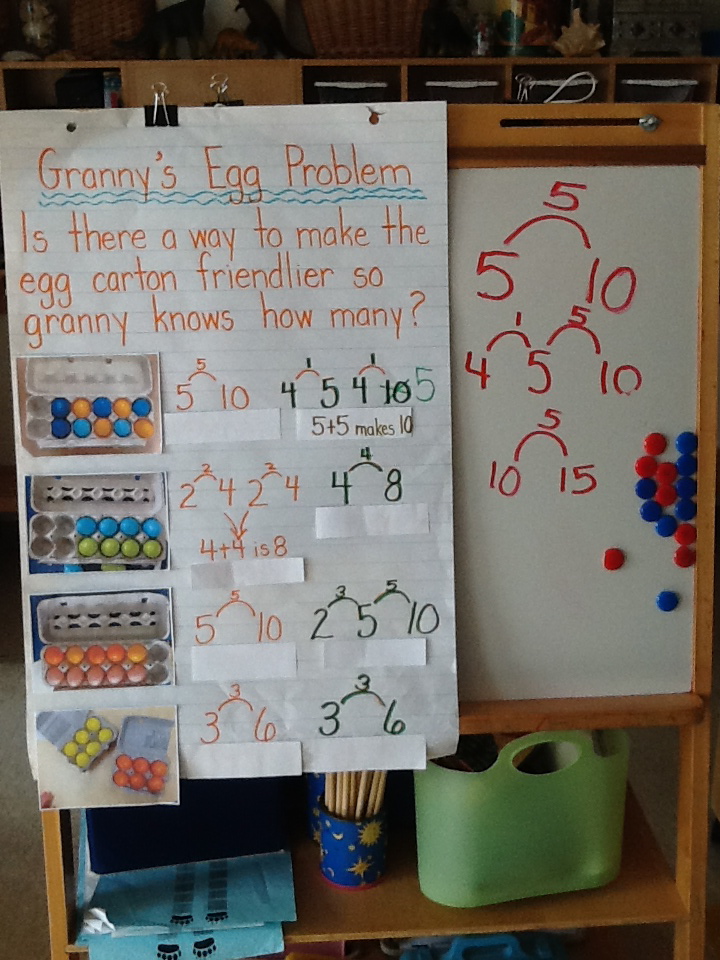
When we met together as a group (math meeting) to share findings, students discovered that there were a number of different ideas. As pairs shared their thinking LF suggested we show the information using a 'string' (CL had already done this on his paper!).
*Note: Talking with my colleague Ms. Maxwell (who happens to be my mathematician friend) about this terminology, we decided it is actually an open number line students are using and not a string. I will refer to it as an open number line for the rest of this post and will need to re-visit this idea with my students.
As students talked I recorded exactly what they were saying. Take a look at the first carton design and how student #2 explained his thinking. I was in a bit of a dilemma here as this is exactly the way SB provided his information and nobody questioned it at the time. Students are always encouraged to try to explain their thinking ("How many?" "How do you see it?"), skills we practice when using dot plates, quantity number line and rekenrek. In this case, I re-voiced what he had said (one of the talk moves) to assure SB his idea had been heard and to see if SB or anyone else might question the thinking.
MJ - So SB, you said 4 and 1 makes 5 and 4 and 1 makes 10.
SB - And 5 and 5 makes 10
The following day we worked together again on the SMARTboard, having students pretend they were granny and sharing their thinking about a carton that wasn’t theirs.
Cartons were captured on the SMARTboard using the document camera and students were invited to share their thinking.
MJ - CB if you were granny what would you see?
CB - 5 and 5 makes 10.
MJ - Can you show us? Use the marker and show us where your eyes are looking. (CB circles top row of eggs and then bottom row of eggs)
MJ - CB has gone for bigger groups. She’s got 2 big groups. What do you think about that?
RH - It’s 8.
MJ - What would you say to CB?
(CB tags and counts 1 to 8 as RH says this).
CB - It’s 8.
RH - Because if you took 4 away and then 4 more ..... 2 more 4’s that makes 8.
MJ - SB what are you thinking?
SB - 8
MJ - How do you know it’s 8?
SB - There’s 4 on the top and 4 on the bottom makes 8.
MJ - Oh so you agree with RH. CB what are you thinking?
CB - It’s 8.
MJ - So you’ve changed your mind?
MJ - RH how many?
RH - 12
MJ - Altogether? (RH nods yes) But what have they done to make it easier for granny?
RH - Cut it in half
MJ - Do you think that helped?
RH - She would have to probably count it first.
MJ - What do you think would make it easy for granny to know how many? (pause)
MJ - BG what do you see?
BG - 3 and 3 make 6.
MJ - CL what did you hear BG say?
CL - 3 and 3 makes 6 but what does 6 and 6 make?
MJ - CB what did you do to the carton?
CB - We cut them in half.
BG - 12
CB - It’s not 6 and 6, it’s 3 and 3 makes 6.
MJ - Yes they just made the carton smaller. Nobody said we couldn’t make the carton smaller.
RH - 3 and 3 makes .....
BG - 12
RH - No I’m looking at this 3.
MJ - And how many would that be?
RH - 6.
MJ - What would that look like?
RH - 3 and 3 makes....
BG - 12.
RH - No I’m looking at this 3 (points to one of the carton halves).
MJ - And how many would that be?
RH - 6
MJ - If you were granny what do you see?
KB - 5 and 5 make 10
MJ - Oh so he has gone for the bigger grouping. Show us what that would look like. (KB circles groups of 5 on SMARTbd)
MJ - How many people saw the 5 and 5 makes 10?
Rh - Yeah cause I did that.
MJ - What would that look like? (referring to recording this information)
CB - That 5 and 5 makes 10.
KB - I think I know what it would look like. I know how to do 5 cause it’s in my Valentine's book.
During our literacy block the next day, students were given the challenge of writing granny. The anchor chart developed with photos of all the different ideas was posted and students could choose which option they thought would be most efficient for granny. That meant they could choose their own or somebody else’s idea if they thought it was more efficient.
Some students reflected on writing strategies they were using while writing their letters:
EA and LF accessed books from their reading boxes for words they needed. EA was looking for the word two and found it in Dilly Duck and Dally Duck.
CL wanted to know if eat (a word he had stretched) and 8 are the same?
CB and CL asked how to spell the number word four. We talked about how tricky some number words are because your cannot hear all of the sounds. The suggestion was made that perhaps it would be helpful to post number words in our classroom.
Here are some of our letters! We have e-mailed Ms. Maxwell to ask if she could deliver the letters to her granny.
It will be so exciting to hear what granny thinks of our designs!
Five and five makes ten.
Two and 3 makes 5 and 5 more makes 10.
I cut the egg carton in half.
Two and two makes four. Two and two makes four. Four and four equals eight.
Two and two makes four and another two makes six and two makes eight (spelled AT for eight although hard to see in picture).
MJ - SB what would you tell granny?
SB - 4 and 1 is 5 and 4 and 1 is 10 and 5 and 5 is 10.
(**Remember the earlier conversation with SB?)
MJ - So how many did you have in your carton?
SB - 4 and 1 makes 5 and 4 and 1 makes 5 and 5 and 5 makes 10.
NOTE: I didn’t want to do a “tell” with the open number line but when nobody questioned the idea that 4 and 1 makes 10 I decided on the following day to re-visit this with the group:
MJ - I’m looking at this and I’m confused. SB you said 4 and 1 is 5 (pointing to first open number line) and 4 and 1 is 10 (pointing to second open number line).
SB - (frowns) No 4 and 1 is 5 and 4 and 1 is 5 and 5 and 5 make 10.
MJ - Hmm what are you thinking?
SB - 4 and 1 make 5 and 5 and 5 make 10.
MJ - Should we change this?
SB - Yes.
Over the following days small groups continued to work with granny’s egg problem. Two groups who were having trouble the first day deciding on how to make the carton friendlier were given additional time to work together. The focus continued to be “How many?” and “How do you see it?”
Some of our very young students were challenged with figuring out “How many in the carton?” My documentation focused on 1:1 (which was the strategy they naturally default to at this stage), stable order, cardinality, and in some cases subitizing.
JT made a connection to dot plates when playing this game and got the plates to demonstrate how some of the eggs in the carton could look just like the dot plates.
JT - If you take the dot out it looks just like the eggs (he was talking about the middle dot of a five formation dot plate) as he points to four eggs he put in the carton! (Sorry no photo!)
He created challenges for himself, attempting to match a dot plate amount with the same number of eggs. Normally dot plates are used for flashes but this game was his own invention as he attempted to make connections to how many.
We hope Granny writes back to us soon!